
Houellebecq and Burroughs
Comparing two great writers who may seem rather different at first glance.

Because of my interest in the Beat Generation and my knowledge of their lives, I often find myself thinking about them when reading modern literature even when there is no obvious connection. I read a lot of contemporary feminist Japanese fiction and I routinely ask myself, “What would Allen Ginsberg have thought of this book?” or “I wonder if she was thinking of William Burroughs when she wrote this part…” which is of course ridiculous. However, I cannot help myself. The Beats have wormed their way so thoroughly into my brain that they frame my reading of decidedly non-Beat literature.
Then again, when it comes to Western literature, I do believe a vast amount of it is—whether directly or indirectly—influenced by the Beat Generation and so the connections here are not always so tenuous. That includes my favourite living writer: the 21st century’s foremost enfant terrible and poète maudit, the much-maligned Michel Houellebecq.
I am aware that a good percentage of people reading this will probably detest the author and his work or perhaps have merely heard bad things. He certainly has a habit of making provocative statements or at least being quoted in ways that make his views seem outrageous. That is of course one obvious connection between Houellebecq and Burroughs, the master of outrageous pronouncements. Like the French author, Burroughs used fiction, essays, and interviews to put forth his views and sometimes said things that—when taken literally or viewed in too orthodox a sense—sounded offensive, silly, or outright crackpot. However, I believe both men were and are geniuses even if flawed ones.
But why am I talking about Houellebecq and Burroughs? Why draw this connection? There is no great reason except that Burroughs’ name cropped up in two Houellebecq novels I recently read. These weren’t exactly substantial references. Houellebecq did not write at length about Burroughs, nor did he express any particular admiration for his work. He merely noted the Beat author’s appearance:
“At the end of the sequence, a fat man with very black hair, a face that was shiny and pockmarked by syphilis, and who also wore a black double-breasted suit, got out of the back of the car, accompanied by a skeletal and sinister old man, looking a bit like William Burroughs, whose body floated inside a grey raincoat.” (The Possibility of an Island, p.137)
“He looked a bit like Professor Phostle, the old astronomer in the Tintin story The Shooting Star, but also a bit like William Burroughs.” (Annihilation, Kindle edition, no page number)
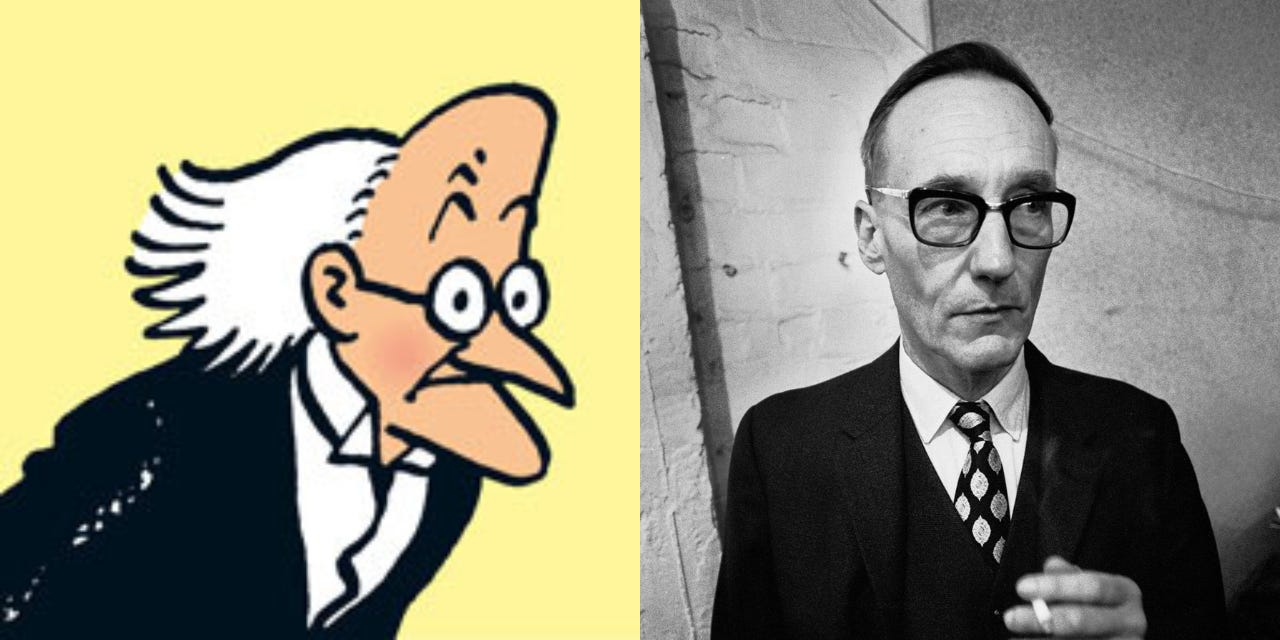
The fact that Houellebecq mentioned Burroughs twice suggests to me that perhaps he knew a little more about the Beat writer than his reputation and appearance, but there is nothing further to go on. I see no examples of Houellebecq naming Burroughs in his interviews or other published work. Yet those two little meaningless statements put me on a certain mental track and the authors became more entwined in my mind. I began asking, “How much of Burroughs has Houellebecq actually read? What does he think of him? (Houellebecq can be very bitchy about other writers; he quite possibly dislikes him.) Did he go through a Beat phase? Does he read other Beat writers? Did he read Burroughs in French or English? Has he taken any influence?”
To be honest, my French is merde. I have barely spoken it in 25 years and have only ever read one novel cover to cover in that language, and I probably understood only half of what I read. Thus, I’m not exactly in a position to scour the original sources for references, so what I’ll discuss here are simply some connections that I see from my admittedly biased position as a huge fan of both writers, using English translations of Houellebecq’s books.
I mentioned above the rather obvious fact that these are writers considered literary outlaws, whose provocative statements tend to offend and enrage, but whose detractors usually are forced to make concessions along the lines of: “Well, he’s an asshole but goddamn he’s a good writer.” But of course, they are hardly the only two writers who’ve possessed that particular attribute. In fact, French and American literature are filled with literary figures both loathed and loved in almost equal measure. The cultures are brimming with curmudgeonly geniuses and poetic cranks. However, I look at these two men standing in their historical contexts and see more than just your typically abrasive writers with penchants for breaking taboos. I see men obviously possessed of creative brilliance but whose appeal tends to come from an odd fusion of common sense (a rare commodity now as in the fifties) and fringe lunacy. They look at their world and see with surprising clarity the reality that the dominant culture and faddish academia tend to ignore or simply not perceive, and they report it frankly in a way that appeals to a group of readers sick of the more fashionable approaches. At the same time, they both have a weakness—likely stemming from childhood trauma—for crackpot ideologies and less reputable belief systems. Their honest exploration and willingness to explore the weird and fearlessly state the plain is something that I think connects them.
The way that they achieve this is something I find that also connects them. Both writers tell stories but neither could be said—unless one was being charitable—to be a great storyteller. I do not mean that as any sort of insult. Most popular writers are storytellers who simply adhere to formulae. Burroughs and Houellebecq, on the other hand, could be viewed as philosophers. At least from my perspective, they seem to view the novel as a means of conveying ideas rather than entertaining their reader with carefully plotted narratives. Burroughs famously eschewed character development and often considered plot unimportant and whilst Houellebecq has much of the former in his books, he is a bit loose with the latter. Altogether, one reads his books as a series of magnificent sentences, poetic and hilarious and of unparalleled perceptive intelligence and bravery. There is usually some plot but sometimes it is forgotten and it is never really that interesting but you keep reading because sentence by sentence you are blown away by his brilliance. This is precisely how I feel about Burroughs. I’m sure many will disagree and certainly there are books for which this does not hold entirely true, but generally I find you can open certain of his works and simply read random sentences or paragraphs, laughing out loud and admiring his weird and fantastic mind. That is, I think, why he is so popular, and I believe the same is largely true of Houellebecq.
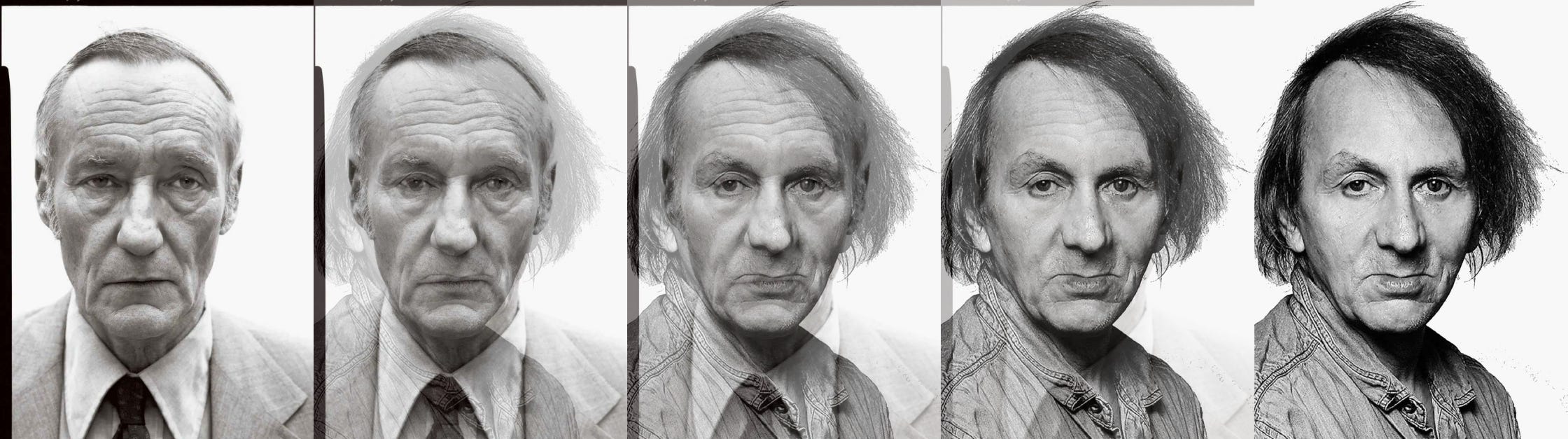
Do people normally think of Burroughs and Houellebecq as comic writers? I am not sure but certainly that’s how I view them. They are the only two writers who genuinely make me laugh out loud, and I do not see that as being at odds with my claim to their being great thinkers. In The Possibility of an Island (one of the books in which Burroughs is mentioned), Houellebecq’s protagonist is a successful comic who has recognised the role of the clown as a means of offering a society introspection. My reading of this was that Houellebecq saw himself in this position, skewering modern French society in a way that is often comedic. His books—just like the comic sketches of his protagonist—are violent, repulsive, and almost always horrendously accurate. They would probably be rather dull as essays but as novels they are enjoyable. One could say the same for much of Burroughs’ work. Strip away the wit and it is unbearably bleak, yet embrace the comedy and you can better engage with the depressing absurdity of reality that he shows you.
This is particularly important when the subject matter depicted is so sensitive. Both writers are willing to break any and all taboos. I hardly need to mention the content of Burroughs’ early work, which was so shocking that it was often banned. Houellebecq similarly feels the need to discuss paedophilia and grotesque violence. Like Burroughs, he does this with shocking flippancy. Houellebecq seems obsessed with the downfall of Western civilisation, attacking that which he sees as wrong. Burroughs, I feel, was much the same. Both men were frighteningly perceptive and utterly uninterested in self-censorship, which is perhaps the reason they were and are so admired. Of course, not everyone admired them… not by a long shot. Both writers have been described by mainstream and academic critics as “vulgar” and writers of “pornography,” with their work frequently labelled “offensive” and “obscene.” But as Burroughs said, “These so-called critics aren’t worth their weight in ruptured condoms.” (This quote comes from The Bunker Diaries.)
Yet another connection is that of prophecy. I have written before—in a silly, half-serious article—about Burroughs’ prophecies that came true. Famously, he wrote a number of ideas into books like Naked Lunch that later seem to have been prophetic and Houellebecq is the same. He wrote about Islamic fundamentalism prior to 9/11, predicted the farmers’ protests before they happened, and was on the cover of Charlie Hebdo the morning gunmen broke in with the aim of silencing freedom of speech. Of course, neither man saw the future (no matter what Burroughs said about the power of cutting things up). They were simply intelligent men who kept their eyes open.[1] They stayed away from political movements and wrote honestly about what they thought might happen given what was evident around them, and of course that passes for prophecy when it is merely probability.
Both men are famous as writers but as I’ve said they are perhaps philosophers using the novel as a means of spreading a message. Yet the novel was not the sole form of artistic creation for these men. Both were and art multidisciplinary artists. Both wrote fiction and non-fiction, as well as poetry and spoken-word recordings, and both have engaged to some degree in film and photography and visual art. As thinkers and creatives, they are not bound to one form of creation; they are highly experimental and always eager to test their ideas in other media.
Another connection is technology. Burroughs was fascinated by technological innovations and these crop up often in his books. Houellebecq is the same. My reading of their works tells me Burroughs was quite optimistic about the potentials for technology, feeling that individuals could take advantage of new technologies to resist methods of control, and he obviously tried to incorporate technology in his own artistic endeavours, but this is in contrast to what I get from Houellebecq’s novels, in which technology seems more at odds with humanity. Houellebecq depicts advanced technologies as alienating and capable of abusing individuals and restricting their freedoms. We see in his books characters finding meaning and contentment away from their devices and in the natural landscape (usually the French or Spanish countryside). I wonder what Burroughs would’ve thought had he lived to see the technologies of the 21st century and their very negative impact on human life. Perhaps his incorporation of it in his novels would’ve been more similar to Houellebecq’s…
We should not omit the various differences even when drawing connections between these two writers. For one thing, Houellebecq is quite romantic and for all he is seen as a cynic and curmudgeon, his books are filled with the ideas of salvation through love, the beauty of nature, and to some degree a respect for tradition. He is often called Islamophobic and yet he has written about the beauty in that religion and certain of its values. His books feel bleak in certain ways, but there is always some sort of hope, some effort to find the positive even in the seemingly depressing. You certainly see a lot less of this in Burroughs’ work. We find hints of it in his letters and writings from his later years but certainly the majority of his fiction is at odds with Houellebecq’s romanticism. He seems more of the view that love is yet another virus, a biological problem to be overcome,[2] whereas Houellebecq sees organisations as the problem and love as the answer.
Then, when it comes to narrative, they are worlds apart. I mentioned earlier that Houellebecq sometimes seems to abandon plot, having become more concerned with stream-of-consciousness philosophical inquiries but for the most part he is an extremely clear and concise writer. In trying to find quotes Houellebecq may have made in the media about Burroughs (I could find now), I often accidentally found people saying things like, “He’s a lot like William Burroughs… but easier to read.” There is a lot of truth in that though I suppose it depends on how well you know Burroughs’ various interests and techniques. Once you’ve the key, you’re in the door and his books open up nicely. But anyone could pick up a Houellebecq novel and follow along with ease.
Altogether, I see these writers as essential critics of their societies. They were and are widely reviled for their views and their art, but I think most of the hate has come from a fundamental misunderstanding and a sense of unease at their depiction of the reality of the world that most people turn to fiction in order to escape. Houellebecq in particular, as a man who has chronicled the 21st century, is a very important writer whose books are helpful in guiding one through this strange and terrible time, and I hope that anyone reading this essay who is not yet familiar with his work considers giving him a chance. I reviewed his most recent book last year:
Annihilation, by Michel Houellebecq – A Review

It is quite rare that I look forward to the release of a new book. Generally, I like working my way through older texts—ones that have stood the test of time and whose beauty and wisdom are nearly assured. When you buy a new book, of course, it might be terrible. Perhaps that sounds ridiculous, but we are only here on Earth for a short period of time an…
[1] “That’s my principal message to writers: for God’s sake, keep your eyes open.” Burroughs gave this advice for aspiring writers in an interview with the Paris Review. More Beat writing advice can be found here.
[2] Burroughs’ final journal entries show a late acceptance of love. The final lines of Last Words are “Love? What is it? Most natural painkiller what there is. LOVE.” (p.253)
As an extra note Houellebecq is pretty easy to read in French. Many critics dislike him as he uses everyday language and short simple sentences, and uses a very flat style (which also makes him easy to translate). Houellebecq is aware of this I think which is why he called one book "Platform"= plat (flat) forme (shape)
Naked Lunch is a comic masterpiece, no doubt. I would hesitate to call much of Burroughs' other work overtly comic (although, strangely, it can become comic when he reads it himself).